Dan Mayor, owner of one of the most emblematic record stores in Spain, opens up on vinyl resurgence, streaming culture and the future of the industry
“When I listen to an album, I don’t do anything else”. Eleven words that help to illustrate the character behind Dan Mayor, son of the owner of Disco 100, one of Spain’s biggest vinyl stores. Above all, Mr. Mayor is a music freak, his knowledge part of the reason he has succeeded his parents at the helm of Barcelona’s very own music sanctuary. Founded in 1978, Disco 100 is widely considered Spain’s largest first hand record store, with a catalogue of more than 117.000 references, a sum that also includes CDs.
iMusicate contacted Mr. Mayor for an interview and got access to insights on the vinyl industry’s remarkable resurgence, the cultural role of record stores, younger generations, the sector’s future and more.
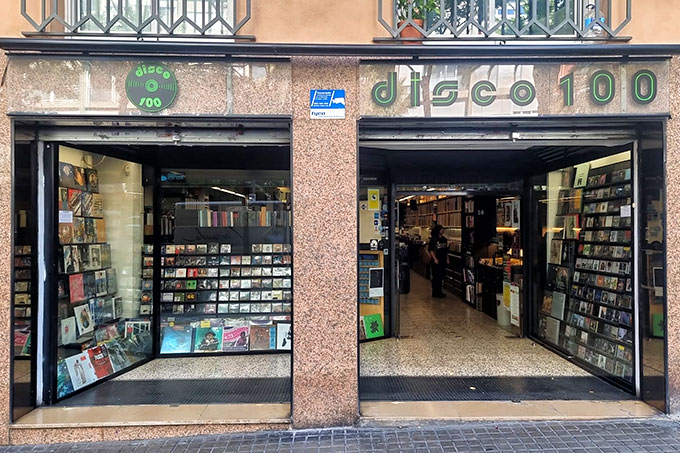
Q: How has the demand for vinyl records changed over the years, and how has that affected Disco 100?
D: In the second half of the 1980s, CDs became dominant. More or less from 2000 until 2007 we didn’t have vinyl records at all.
Then we started stocking vinyl again, partly out of persistence. The major labels weren’t producing vinyl anymore. The stores that survived basically did so because they mainly sold second-hand records and vinyl from small labels. From 2007 onwards, there started to be demand for vinyl. We began selling vinyl again. The major labels also started offering vinyl. We went from having none to carrying between 15,000 and 20,000 different vinyl references in stock.
We still sell CDs. We have between 15,000 and 20,000 vinyl records, but we probably have over 80,000 CDs. And we still sell them more or less in that ratio during normal periods. Around Christmas, the ratio becomes more even. Since vinyl records are much more expensive, in terms of revenue things are more balanced, though not in terms of units sold. We sell roughly four CDs for every vinyl record during the year. During special periods like Christmas, that gap narrows. And now, for example, we’ve just had Record Store Day, so the difference narrows even more because Record Store Day is very focused on vinyl.
Q: How would you describe differences between vinyl and CD?
D: As an object, vinyl is much cooler than CDs. At the beginning, there used to be a text on the back of CDs saying: “We apologize for not being able to reproduce the sound of vinyl with complete fidelity.” Because CD sound can be very good, but it’s still an approximation of something analog.
However, most people don’t have sound systems at that level. They can buy vinyl, but they don’t have the equipment to listen to it properly. Most people can’t afford the kind of equipment that costs a lot of money. I’m not judging whether that’s the right way to listen or not, because everyone has their own priorities and does whatever they want. I’m just saying that a lot of people listen on their phones, and phones obviously have limitations. You don’t get the range that a good amplifier can provide.
Q: How would you describe changes to your clientele?
Things have definitely changed. At first, when we didn’t sell much vinyl, the people buying it were a very specific type of customer, mainly indie fans or people looking for rare records. And they had a certain age range, right? That audience was mainly men between 30 and 60. Although at Disco 100 there has always been a bit of everything because it’s a store that covers all styles. We don’t focus on just one genre. We cover everything.
I think now the audience is less male-dominated; there’s more diversity. And I’d say that since the pandemic, especially from 2022 onwards, there have been years when vinyl records became Christmas gifts for younger people. There’s a much younger audience now, between 15 and 25 years old. And yes, the Taylor Swift crowd also buys a lot of vinyl. On Record Store Day, the best-selling record was Taylor Swift. The record we had the most copies of sold out before the store even opened, and that was 30 units of a Taylor Swift single.
So yes, the audience has changed. Younger people have joined in, and it’s no longer just men. It’s a bit of everyone.
Q: How do streaming platforms influence your sales?
A lot of people tell me: “Yeah, I listen to it on Spotify first, and if I like it, then I buy the vinyl”. Maybe very famous albums don’t sell as much as they used to. But overall it hasn’t affected us that much, given our wide variety. Our thing has always been that people browse and pick a bit of everything. The way I see it, people now listen to an album first before buying it and enjoy it more beforehand.
“Music is now something people listen to while doing something else. I think people coming from digital culture multitask while listening. I’m not a multitasker”.
Q: Do you think people experience music differently when listening on vinyl compared to digital platforms?
When I listen to an album, I don’t do anything else. I mean, sometimes I might put on classical music in the background while studying or reading. But otherwise, I put on a record and sit down to listen to it. I don’t do anything else. That’s not normal nowadays. Music is now something people listen to while doing something else. I think people coming from digital culture multitask while listening. I’m not a multitasker.
And for that, there’s no comparison between physical formats and digital. With digital, you’re on your phone, doing a thousand things at once. It’s very hard to leave your phone alone. “When you play a vinyl record, you take it, put it on, sit down and listen”. I wouldn’t say: “My way is the right one”. No. I’ve simply become used to listening to music this way, and the other way feels tedious to me, but that’s just me, because I’m used to this. I don’t think there’s only one correct way to listen to music.
Q: Are there any changes you’d like to see in the sector in the future, in the vinyl store sector?
Nobody has ever asked me what records should be reissued. No label has stopped to think: “Wow, it’s Record Store Day.” It’s strange that Disco 100 has been around for 48 years and nobody has ever asked me what records would be interesting to reissue.
Another thing I don’t like is exclusivity. It annoys me when Amazon releases exclusive editions, it annoys me when Fnac has exclusives, it annoys me when Universal releases exclusives on its website. That bothers me. Why shouldn’t someone be able to buy something just because of where they shop? I’d like things to work differently. Another thing is if the artist says: “This record is only sold by me, only at my concerts”. Fine. But if it’s sold in stores, why can some stores sell it and others can’t? I don’t understand that.
This obsession with exclusives and collecting for the sake of the object also bothers me. For example, when artists release an album and then two months later they release the exact same album with one bonus track, and I already bought it. Why are you releasing it again with one extra song? What is this, do you think I’m stupid? Now I have to buy the album again. Why not wait and release another record, or single? That’s what I’d like to change: not releasing so many editions that are basically the same thing plus one or two extra songs. It drives me crazy. Taylor Swift, for example, released four versions of the same album, each with a different track. That kind of thing drives me insane.
It also bothers me how long it takes for albums to be reissued. There are so many records that just aren’t available. I don’t know what demand is like overall, but at Disco 100 records sell out, we order them again from the label, and they’re unavailable.
Q: If you had to recommend three albums to listen to, which would you choose?
Firstly, Something Else by Julian “Cannonball” Adderley. On this album, the alto saxophone player, Cannonball Adderley, isn’t as famous, but on trumpet you have Miles Davis, and on drums Art Blakey. This is an incredible starting point for jazz. If we move to rock, I’d mention Santana and Crosby, Stills & Nash. Santana’s first album, besides having a beautiful cover, is an incredible record.

The musicianship is amazing. Crosby, Stills & Nash is calmer. And if you follow the groups these four musicians [David Crosby, Stephen Stills, Graham Nash, and Neil Young] were involved in, you build an enormous musical tree because they were connected to so many bands. The first two Crosby, Stills & Nash albums, Crosby, Stills & Nash and Deja Vu, are wonderful starting points. If I had to start with three albums, I’d begin there.
I suppose it’s really about starting from the roots and building from there. You can enter music through so many paths. Because I’ve left out soul music, which I love. And I’ve not mentioned The Beatles. I’m already regretting my three album choices. I could go on forever.


Leave a Reply